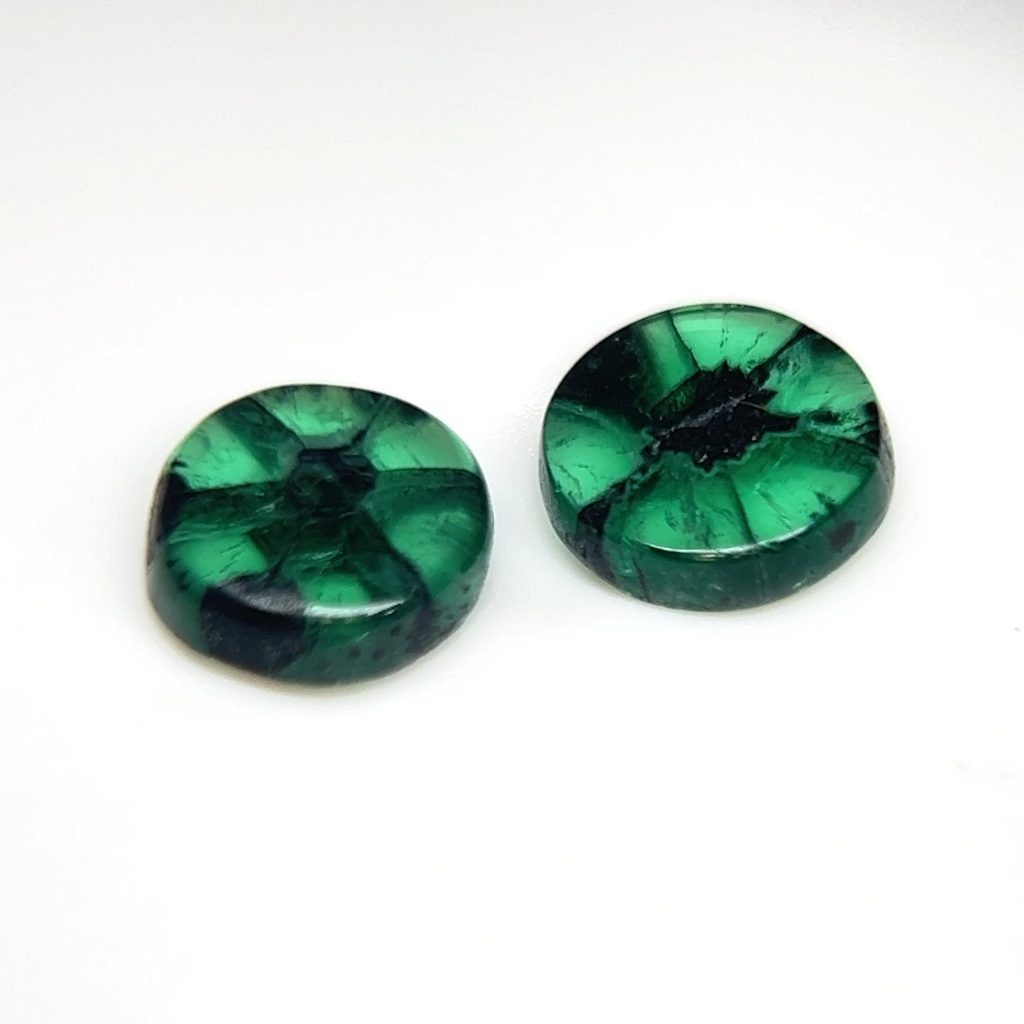
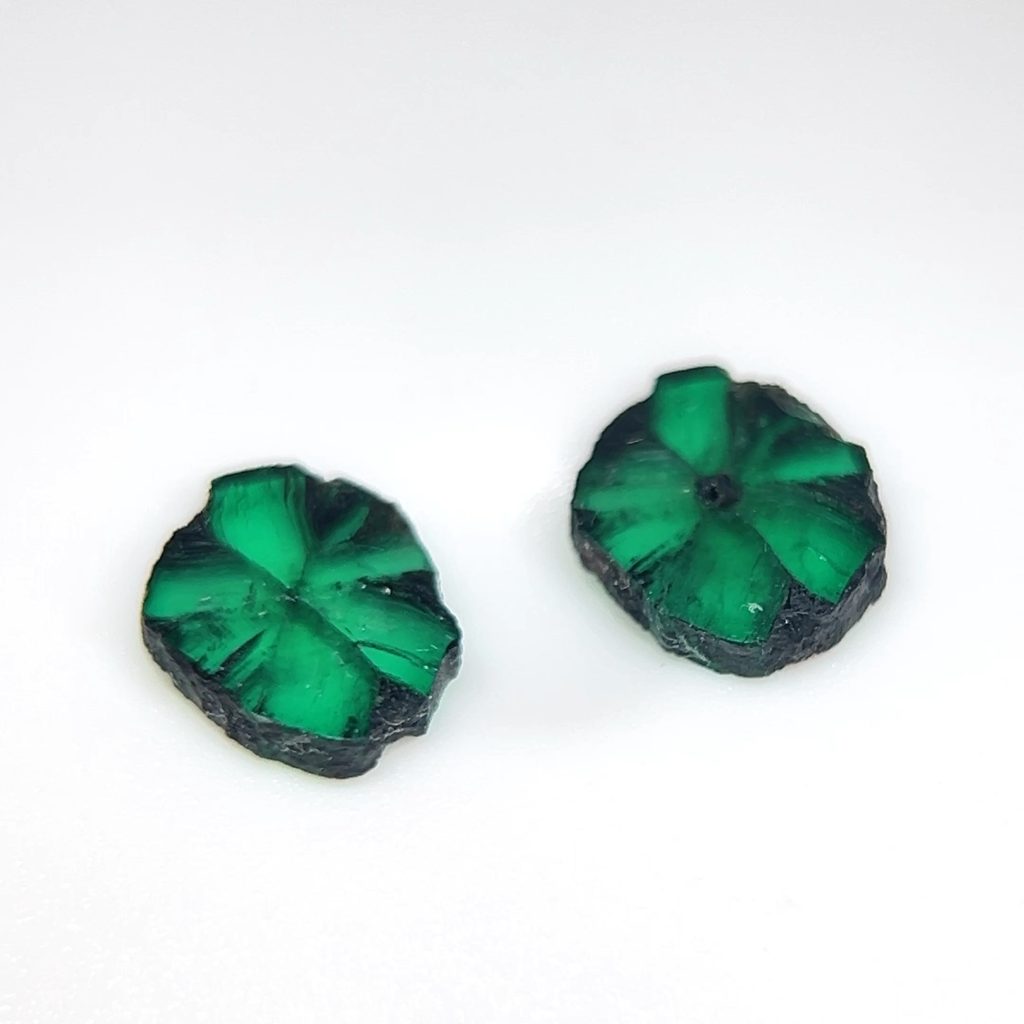
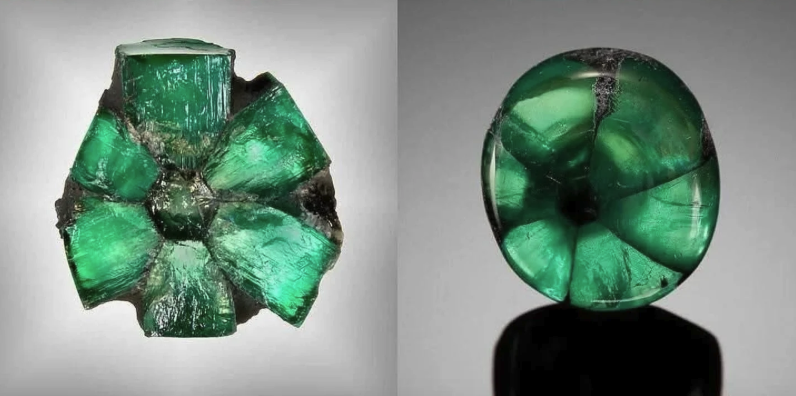
If you’ve ever seen a Colombian emerald, you know it’s special—deep green, glowing with life, and full of mystery. But hidden among these famous gems is something even rarer and more magical: the Trapiche Emerald. These aren’t just beautiful stones—they’re like tiny works of art made by nature itself, with a star-shaped pattern that looks almost too perfect to be real.
Get in touch to explore our exclusive inventory or FREE join our Collector Circle.
The word “trapiche” (pronounced trah-PEE-cheh) comes from old Spanish. It refers to a traditional sugar cane mill used in Latin America. These mills had big wooden wheels with spokes that looked like a star—exactly like the pattern inside these special emeralds! So when miners in Colombia first saw this star-like design inside an emerald crystal, they called it a “trapiche.”
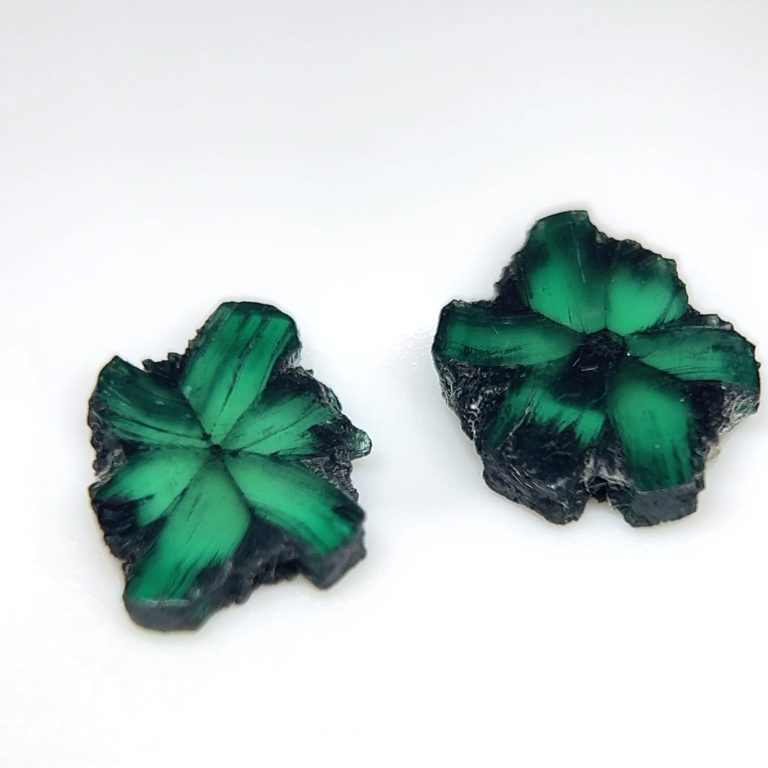
A Trapiche Emerald has a six-pointed star that starts from the center and spreads out to the edges of the stone. The green parts are pure emerald, while the dark lines (the “spokes”) are usually made of black minerals like carbon, clay, or other non-emerald materials. This creates a striking contrast—bright green arms separated by sharp, dark lines—like a green snowflake with a secret.
These regions have the perfect mix of heat, pressure, and mineral-rich fluids deep underground that allow emeralds—and especially Trapiche Emeralds—to form. Outside of Colombia, very few true Trapiche Emeralds have ever been found, which makes them even more special.
What Are trapiche emerals Made Of?
Like all emeralds, Trapiche Emeralds are a type of beryl, a mineral made mostly of:
Beryllium
Aluminum
Silicon
Oxygen
What gives emeralds their famous green color is a tiny amount of chromium or vanadium mixed into the crystal. In Trapiche Emeralds, the green parts contain these coloring elements, while the dark spokes contain no chromium or vanadium—just other minerals like:
Carbon (which looks black)
Albite (a white or gray feldspar mineral)
Quartz or clay minerals
These dark minerals don’t sparkle like emerald—they’re more like natural “frames” that outline the green arms and make the star stand out.
How Do Trapiche Emeralds Form? (In Simple Terms)
Imagine a tiny seed crystal of emerald starting to grow deep inside the Earth—about 2 to 5 kilometers underground. Normally, emeralds grow slowly in cracks filled with hot, mineral-rich water. But for a Trapiche Emerald to form, something unusual has to happen.
Here’s a step-by-step look at how it works:
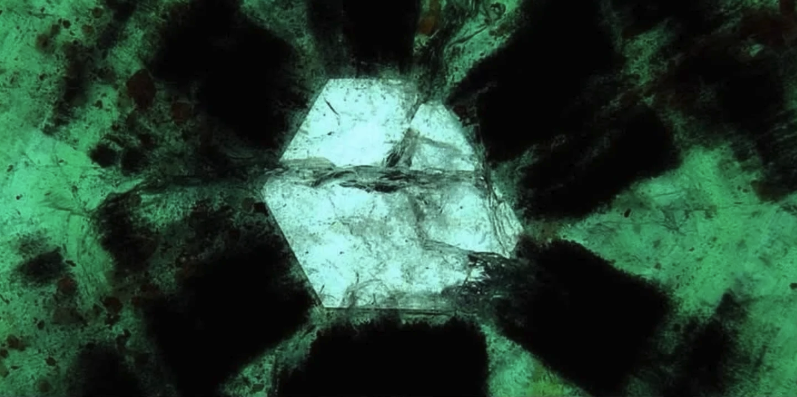
It starts with a center: A small hexagonal (six-sided) emerald crystal begins to grow.
Other minerals get in the way: As the emerald tries to grow outward, tiny particles of black carbon, clay, or silica-rich minerals (like albite or quartz) are floating in the same space.
The emerald grows around them: Instead of pushing the impurities away, the emerald crystals grow between these dark materials. Think of it like six green “arms” growing outward, but they can’t cross the dark stuff—so the dark material gets trapped between them.
The star is born: Over thousands or even millions of years, this process creates the classic six-rayed star pattern. The green parts are pure emerald; the dark lines are the “walls” made of other minerals that blocked the emerald’s growth.
This only happens under very rare and specific conditions—just the right temperature, pressure, and mix of chemicals. That’s why Trapiche Emeralds are so uncommon. In fact, less than 1 in 1,000 Colombian emeralds shows this pattern!
Trapiche Emeralds are prized for three main reasons:
Extreme rarity – They’re found almost only in Colombia, and even there, they’re very uncommon.
Unique beauty – No two Trapiche Emeralds look exactly alike. Each has its own pattern, like a fingerprint.
Natural wonder – They’re a perfect example of how nature can create art without human help.
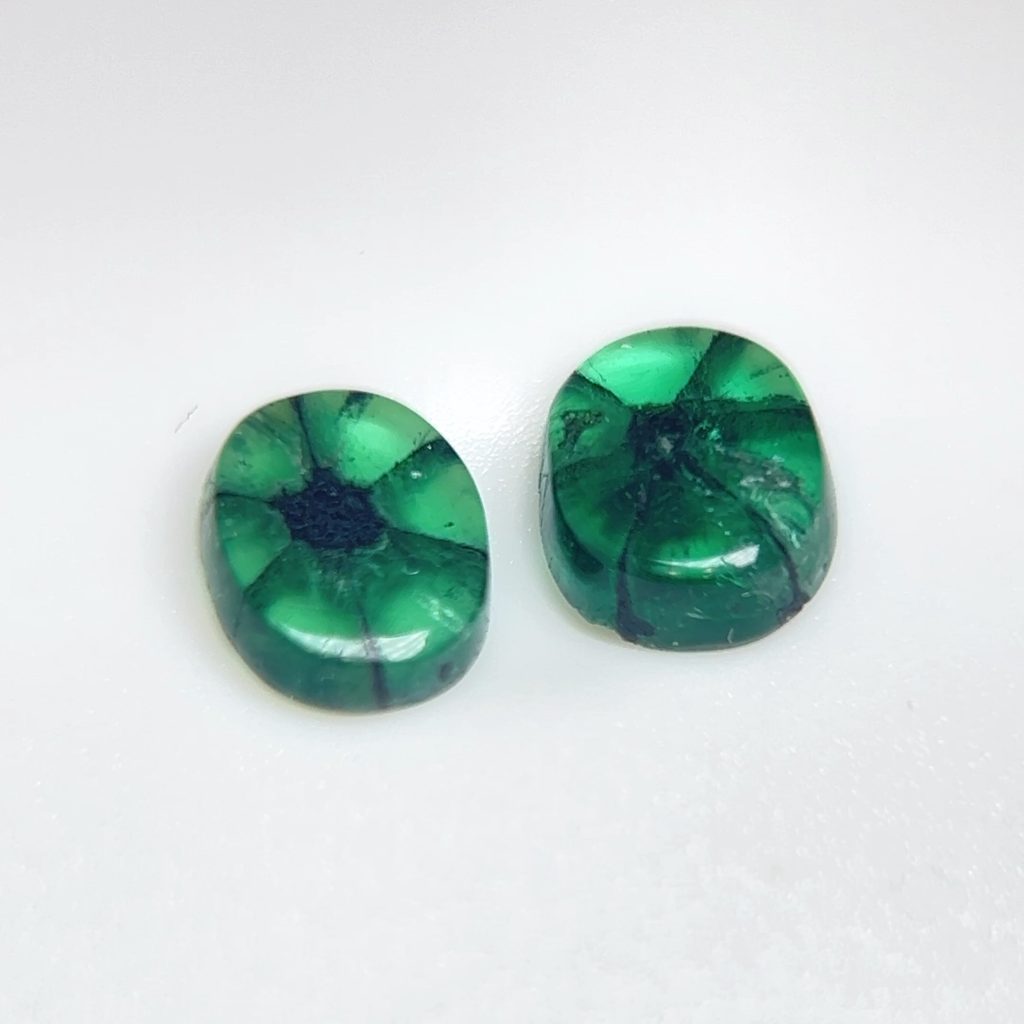
Because of their delicate internal structure, they’re usually not cut into traditional faceted gems (like round or oval shapes). Instead, they’re often polished into cabochons (smooth, rounded domes) or carefully cut to show off the star pattern without breaking the stone.
A Trapiche Emerald is a rare type of Colombian emerald that displays a unique six-rayed star pattern. The green emerald “arms” radiate from a central core, separated by dark lines made of minerals like carbon or clay. The name comes from the Spanish word trapiche, meaning a traditional sugar mill with a similar star-shaped wheel.
Almost all genuine Trapiche Emeralds come from Colombia, specifically from the famous mining regions of Muzo, Coscuez, and Chivor. While a few similar stones have been reported elsewhere, true Trapiche Emeralds—with their distinct growth pattern—are considered exclusive to Colombia.
They form deep underground under very specific conditions. A central emerald crystal begins to grow, and as it expands outward in six directions, impurities like carbon or clay get trapped between the growing emerald sectors. This creates the dark “spokes” that separate the green arms, forming the star-like pattern over millions of years.
Most Trapiche Emeralds are not treated because their value lies in their natural pattern. Unlike regular emeralds—which are often oiled to hide fractures—Trapiche Emeralds are usually left untreated to preserve their unique internal structure. Always ask for a gemological report to confirm.
Extremely rare! It’s estimated that fewer than 1 in 1,000 Colombian emeralds show the Trapiche pattern. Their formation requires a perfect balance of geology, chemistry, and time—making them one of the rarest gemstone phenomena in the world.
Yes, but with care. Because of their complex internal structure and natural inclusions, they’re more fragile than typical emeralds. They’re often cut as cabochons (smooth, domed stones) or set in protective settings like pendants or earrings—rather than rings that face daily wear.
The dark spokes are not emerald—they’re made of other minerals that formed alongside the emerald crystal. Common materials include carbon, clay, albite (a feldspar), or quartz. These minerals block the green emerald from growing in those areas, creating sharp boundaries.
Look for a geometric, six-arm radial pattern that originates from a central hexagonal core. The pattern should be visible from the top and often extends through the stone. A real Trapiche Emerald will also come with a certificate from a trusted lab (like GIA, Gubelin, or AGL). Be cautious of imitations or dyed stones.
No. Some gems (like certain garnets or synthetic stones) may mimic a star pattern, but only natural Colombian emeralds with the specific crystal-growth structure qualify as true Trapiche Emeralds. Also, “star” effects caused by light reflection (asterism) are different—Trapiche patterns are structural, not optical.
Their value comes from rarity, origin, and natural artistry. They’re found almost only in Colombia, form under incredibly rare conditions, and display a one-of-a-kind pattern that can’t be replicated in a lab. Collectors and museums prize them as geological masterpieces—not just as gems, but as natural wonders.
Get Your Personalised Emerald
Receive expert guidance based on your budget, preferences
Download a PDF & Subscribe for occasional emails with important content, product updates and tips
By supplying your contact information, you authorize us to contact and promote our services to you on and across different services in accordance with our Privacy Policy.