

What is emerald and their colour?
Emerald is one of the most recognised gemstones worldwide for its intense green colour and wonderful inclusions. They are found in various regions throughout the planet, especially in areas with specific rock sedimentation.
For over 3,000 years, emeralds have been highly sought after, just like rubies, sapphires and diamonds. Emeralds have been considered as one of the four gemstones in ancient civilisations of Asia, Africa, Russia and South America. They belong to the family of green gemstones and are made of the mineral beryl. Also, emeralds are recognised as zodiac stones and belong to people born in May.
Emerald colour
Emerald’s characteristics include a hard texture, a hardness of 7.5–8 on the Mohs scale (rating ranging from 1 to 10), and a pure and intense green colour.
Emerald is characterised by an intense as well as a strong and bright green colour. This is due to traces or impurities of chrome and vanadium. However, different shades can be distinguished: from the emerald green colour to medium, dark or yellowish greens.
Gemmology experts affirm that emeralds have inclusions on their surface and interior. This stone is more brittle than other types of beryl, which is why it needs to be treated with much more care and gentleness.
In addition, emerald fans say that they have gardens inside, referring to the inclusion patterns that are their identity seal or fingerprint. However, on many occasions, all these stones are treated with oils and resins in order to fill some cracks and improve their appearance.
Emerald is characteristic for its own colour, green. This is composed of traces or impurities of chrome and vanadium, hence that colour so intense as well as strong and bright. However, different shades can be distinguished: from the emerald green colour itself to medium or dark greens and yellowish greens.
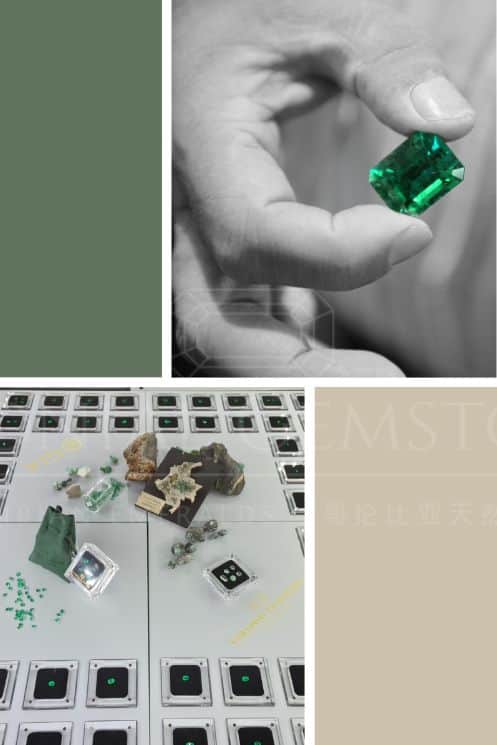
Colombian Emeralds
In the world of gemstones, the Republic of Colombia is famous for its emeralds. The valuable green beryl comes from the legendary Muzo mines, which was already known to the Incas. This famous discovery site is located about 150 km from the capital Bogotá, on the banks of the Miner River.
The morphological and geochemical characteristics of the Colombian emeralds differ from those of other countries.
There are some chemical elements–chromium, vanadium and iron–called chromospheres that give emerald its colour. As compared to other emeralds, the Colombian emeralds have the least iron content, making the green much more attractive. It also has a more beautiful spectrum compared to other emeralds in the world.
Care and Cleaning of an Emerald
Warm conditions aid the cleaning process.
Heating the stone and the cleaning liquid or filler together will open the pores in the stone, allowing for deeper penetration.
A simple overnight soak in a jar of the cleaning medium on a hot plate may be enough to clean the emerald (warm, not hot conditions are required).
Undoubtedly, the jewels in our trousseau are very precious elements. Therefore, it is necessary to know how to care for and preserve an emerald if we have one in our collection.
Not having one would make our jewellery box incomplete. Therefore, an emerald ring for men, a dazzling princess-type emerald bracelet or pear-cut earrings (Link to the catalogue) is essential elements that would undoubtedly give an unmatched beauty to any luxury series.
An emerald represents a keepsake and is generally associated with something special. Like all those things we value, our emeralds require care, and by taking care of them, you would also be taking care of your memory.
Taking care of emeralds fulfils an important function, which is to preserve their quality, brightness and colour. Also, this would keep your memories pleasant, vivid and beautiful.
Today I want to mention some tips that will help you keep your emeralds clean and bright, with their intense green colour and utmost quality, thereby preserving their value and the place they deserve within your jewellery collection.
HOW TO CLEAN AN EMERALD?
First, you should know that cleaning is very simple and requires more care than effort. Dip your emerald in room temperature water and allow it to soak for about three to five minutes to bring the excess impurities to a consistency that is easier to remove. Use a soft-bristle toothbrush and a pH-neutral baby soap. Brush, rinse and repeat one more time. Shake the emerald and dry it with a clean, lint-free cloth.
Always keep your emeralds separate from other stones or jewellery, including other emeralds. Although emeralds are one of the strongest gemstones in the world, they can get scratched by harder stones such as diamond, sapphire or ruby.
Every six months, you can polish your emerald with cedar oil and a clean, lint-free cloth. This will hydrate the gem, enhancing its natural shine without altering its colour or quality.
WHAT YOU SHOULD NEVER, EVER DO!
Never subject an emerald to sudden changes in temperature, especially when it comes to extreme heat (the use of vaporisers or hot water is not recommended).
Do not boil the emerald or immerse it in hot liquid (you will possibly break the stone with this process).
Avoid ultrasonic cleaning as it may break or chip the stone. Never use abrasive materials such as thinners, bleach, alcohol, acetone, grease-cutting detergents or acids.
And always keep in mind that you can take help from a professional. At Colonial Gemstones, we help you keep your emeralds up to your expectations!
Share this with family and friends